
About
Dr. Alison Poulton
Senior Lecturer in Paediatrics, Sydney Medical School Nepean, The University of Sydney
I am a paediatrician specialising in treating children with attention deficit hyperactivity disorder (ADHD). I studied medicine at Girton College Cambridge and Guy’s Hospital London, qualifying in 1982. I trained in paediatrics in Stoke-on-Trent and Birmingham UK before migrating to Australia. I completed my advanced training in Melbourne and Sydney and gained the FRACP in 1993.
I work at Nepean Hospital, at Penrith Child and Youth Mental Health Service and in private practice in Penrith and have raised a family of four children. I was awarded my MD from the University of Cambridge in 2011. This was based on research into the collateral effects of stimulant medication on children’s height, weight, physical maturity and body composition.
Research interests
Three connected areas of research
Clinical practice and research have run side by side since 1996. The questions come from clinic, and what the studies find goes back to families through the explanation sheets.
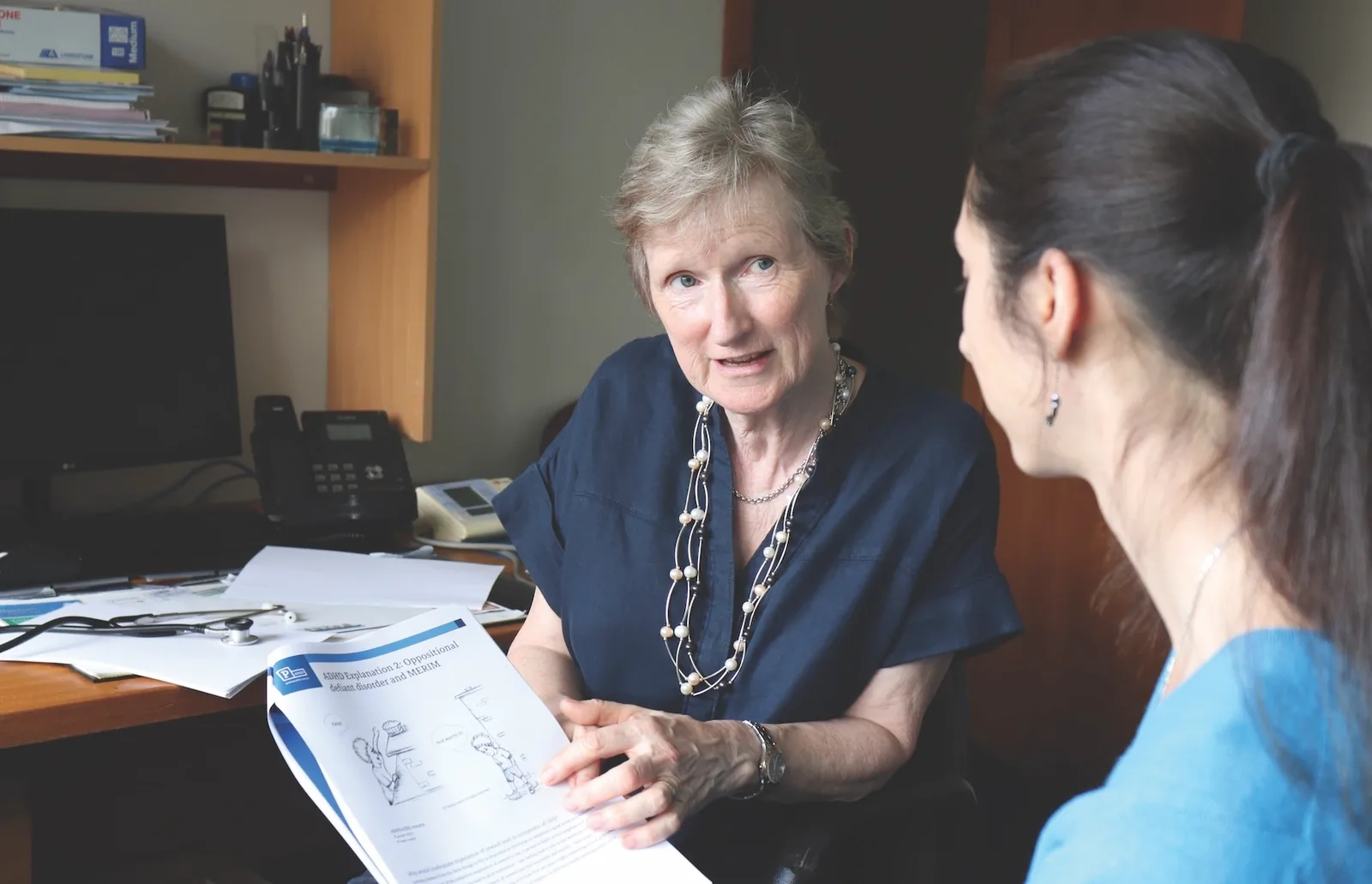
Attention deficit hyperactivity disorder (ADHD)
I have been studying the effects of stimulant medication in children with ADHD since 1996. The initial period of weight loss associated with the appetite suppression that occurs on a stimulant leads to transient slowing of growth and in the longer term, to slower progress through puberty.
Around 40% of children with ADHD also meet diagnostic criteria for oppositional defiant disorder (ODD), which is far higher than would be anticipated by a chance association. I have developed a clinical model, the Mental Effort-Reward Imbalances Model, to explain this.
Obesity
There is substantial overlap between ADHD and obesity; symptoms of ADHD, such as inconsistent motivation and impulsiveness, with lack of meaningful consideration of the consequences of an action, are also common in obesity. The efficacy of the stimulants for treating obesity has long been recognised, but they are not generally considered appropriate due to their abuse potential.
Population based research and data linkage
I am interested in the long-term effects of ADHD and stimulant medication at a population level and have been carrying out a data linkage study of the reproductive outcomes of women with previous stimulant treatment for ADHD. I am planning a study of the cardiovascular effects of long-term treatment.
Free resources
Explanation Sheets
Helping patients, parents and professionals understand about ADHD. Read each explanation online, listen to it narrated, or download it as a PDF.
-
Explanation Sheet 1
What is ADHD?
A lot of people have heard of ADHD, but may not really understand the effects it…
-
Explanation Sheet 2
Oppositional defiant disorder and MERIM
Most children with ADHD (and also many ADHD adults) show some difficult and oppositional behaviour. Explanation…
-
Explanation Sheet 3
ADHD as a continuum
People whose brains function slightly differently often represent more extreme forms of the types of functioning…
-
Explanation Sheet 4
Behaviour strategies for ADHD
This Explanation builds on Explanations 1-3 and describes non-medical strategies for helping people with ADHD to…
-
Explanation Sheet 5
Medications used in ADHD
ADHD is a genuine and treatable condition. Finding the right medication, or balance of medications, can…
-
Explanation Sheet 6
ADHD in adulthood
This explanation describes ADHD as a condition in which the thinking brain functions less efficiently and…