Research
Publications
Research papers, book chapters and the book ADHD Made Simple by Dr. Alison Poulton — with plain-language summaries and downloadable documents.
Papers & chapters
Research publications
27 publications — the 5 written for GPs, with the clinical tools they use, are on the For GPs page
-
Association Between Caregiver Responses to the Six-Item Adult ADHD Self-Report Scale (ASRS-5) and Caregiver-Reported Adverse Childhood Experiences in Their Children
We surveyed 162 caregivers of children attending paediatric services in Western Sydney, asking them the six-question adult ADHD screener and about adverse childhood experiences in their child. Caregivers with higher ADHD screening scores were about twice as likely to report four or more adverse experiences…
-

New model of management of attention deficit hyperactivity disorder by trained general practitioners: Prospective cohort study in 207 children
This was a clinical study in which general practitioners were given training to diagnose and manage ADHD in children. We report on the first 207 children aged 4 to 17 managed through the programme. Families were seen far sooner than on a specialist waiting list,…
-

ADHD in children – practical clinical pearls for GPs
A practical guide for general practitioners to assessing and supporting a child who may have ADHD: looking for functional impairment at home, at school and beyond; picking up associated conditions such as learning difficulties, anxiety, sleep problems and tics; and monitoring medication using rating scales…
-
A Randomised Open-Label Comparison of Dexamphetamine and Methylphenidate in Children With Attention Deficit Hyperactivity Disorder (ADHD): Symptom Response, Adherence and Weight Impact Over 12 Months
Children starting treatment for ADHD were randomly assigned to the two immediate-release stimulants used in Australia, dexamphetamine or methylphenidate, and followed for a year. Dexamphetamine caused more weight loss, but the two medications were otherwise comparable in how well the symptoms responded and in how…
-

Unmet Needs and Service Priorities for ADHD in Australia: AI-Assisted Analysis of Senate Inquiry Submissions
Five hundred and five people with lived experience of ADHD wrote to the 2023 Australian Senate inquiry. We used a large language model to help sort what they said into themes. The cost and the wait for assessment and treatment came up most often, followed…
-

Stimulant treatment for attention-deficit/hyperactivity disorder and risk of first and repeat juvenile criminal offending: a population-based cohort study
Using linked health and court records for people born in New South Wales between 1990 and 2005, we looked at whether young people treated with stimulants for ADHD were more likely to commit a first or subsequent offence on or off treatment. The study measures…
-

Does Dexamphetamine Cause Addiction? A Narrative Review
Dexamphetamine is a standard treatment for ADHD, yet families and clinicians often worry that it might lead to addiction. We searched the published literature for evidence of addiction to prescribed dexamphetamine. Although dexamphetamine may be abused, we found no convincing reports of true addiction.
-

Changing patterns of treatment and prescribers of stimulants for children, adolescents and young adults with attention deficit hyperactivity disorder in New South Wales, Australia: evidence for a treatment bottleneck? – A database study
Using the NSW Ministry of Health’s record of every stimulant prescription, we traced who was treated for ADHD and by whom from childhood into adult life. Treatment peaks at about age 10 and falls away through the teens, and the number of boys to girls…
-
Empowering general practitioners to diagnose and treat attention-deficit/hyperactivity disorder: Insights from an Australian pilot program
A short report on our pilot program training general practitioners to diagnose and treat ADHD in children, with specialist back-up. It describes how the programme was set up and some GP reflections on their experience of treating ADHD in general practice.
-

General practitioners’ attitudes and knowledge about attention-deficit hyperactivity disorder (ADHD): Insights from a survey
We surveyed 213 Australian general practitioners about what they know and think about ADHD, at a time when new models of care were being sought to shorten the wait for assessment. Most GPs were interested in taking a bigger part in ADHD care but wanted…
-

ADHD: community responds to new clinical guidelines
Australia’s first clinical guideline for ADHD arrived in 2022. This piece for the MJA’s InSight+ sets out why it will be hard to put into practice: ADHD costs the country an estimated $20 billion a year, yet there are too few clinicians to assess and…
-

Understanding Attentional Functioning in Adult Attention Deficit Hyperactivity Disorder—Could This Improve Diagnostic Specificity?
The diagnostic criteria for ADHD describe behaviour, not the thought processes behind it. In workshops with adults who have ADHD we asked how their attention actually behaves, and three patterns emerged: complete lapses in attention, partially attending to a task, and multi-tasking, with attention spread…
-
Rules of Oppositional Defiant Disorder: A New Therapeutic Concept
Oppositional defiant disorder can be thought of as a set of external ‘rules’ that a low mood pushes a child to follow – never admit to being wrong, always argue, always try to win. Naming the Rules of ODD lets parents and children recognise when…
-

ADHD in children – what the GP can do
Treating ADHD usually involves a specialist, but there is a great deal a general practitioner can do first. This article for GPs covers how to assess a child with features of inattention, hyperactivity or impulsivity — is the behaviour out of proportion to their age,…
-

Recognising attention deficit hyperactivity disorder across the lifespan
ADHD affects about one child in ten and one adult in twenty, and general practitioners are often the first to see it — or to miss it. This review describes how ADHD evolves at the different stages of life, from the preschool child to the…
-
A community survey of adults with attention deficit hyperactivity disorder (ADHD) and their experience of medication effectiveness
We asked 117 adults attending meetings of the support group ADDults with ADHD about their diagnosis and their medication. Almost all had had symptoms of ADHD since childhood, but the average age at diagnosis was 32. Three-quarters were on medication, and those who were reported…
-

Dose Adjustment of Stimulants for Children with Attention-Deficit/Hyperactivity Disorder: A Retrospective Chart Review of the Impact of Exceeding Recommended Doses
The right stimulant dose for a child with ADHD is found by adjusting it over time, and a few children need more than the recommended maximum. We compared the clinical records of 52 children on high-dose stimulants with 118 similar children on ordinary doses. The…
-

Stimulant prescribing for attention deficit hyperactivity disorder (ADHD): what guides clinicians in their choice of an upper limit for dose titration?
The maximum recommended stimulant doses have little research behind them, and they differ from one state and country to the next. We surveyed clinicians who treat ADHD about what actually guides them when they decide how far to increase a dose. Some clinicians prescribe doses…
-

Evaluation of Methylphenidate Safety and Maximum-Dose Titration Rationale in Attention-Deficit/Hyperactivity Disorder: A Meta-analysis
Methylphenidate is the most widely used ADHD medication, but the evidence for where its maximum dose should sit is thin. We surveyed the published trials to see what happens to side effects as the dose goes up. Higher doses brought more of the expected effects…
-

Involving medical students in a community-based project on ADHD: a novel learning experience
Medical students get little teaching about ADHD, even though it is a common condition. In this research letter we describe how four University of Sydney students were involved in a study of stimulant dose adjustment, testing thirteen children’s response inhibition on a computer task before…
-

Do you ever feel like you are trying to run your brain on a battery that is low on charge?
One of the lesser known symptoms of ADHD is taking ‘mental short cuts’.
-
High Dose Stimulant Medication for the Management of Attention Deficit/Hyperactivity Disorder (ADHD): A Retrospective Cohort Study
A conference abstract describing the first stage of our study of children on high-dose stimulants: the clinical characteristics of the children whom the NSW Ministry of Health had authorised to receive doses above the usual maximum, compared with children on regular doses from the same…
-
Transition in ADHD: attention to the lifespan
We reviewed different models for transitioning young people with ADHD to adult services. The reviewed studies showed that transition may not run smoothly and that the adult services are frequently inadequate. This may result in attrition from treatment or inappropriate discharge from care. The way…
-
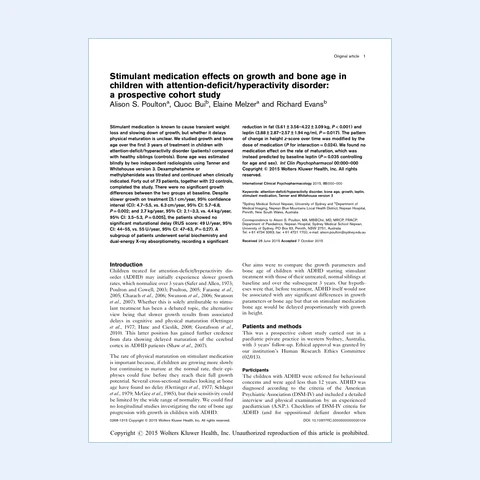
Stimulant medication effects on growth and bone age in children with attention-deficit/hyperactivity disorder: a prospective cohort study
We studied growth and bone age over the first 3 years of stimulant treatment in children with ADHD compared with their healthy siblings. Despite slower growth on treatment, the children with ADHD showed no delay in their bone maturation.
-
Therapy for ADHD Directed Towards Addressing the Dual Imbalances in Mental Effort and Reward as Illustrated in the Mental Effort-Reward Imbalances Model (MERIM)
In this chapter we describe a clinical model for ADHD: the Mental Effort Reward Imbalances Model (MERIM). We use this model to explain some of the behaviour commonly observed in children with ADHD and to guide approaches to treatment. This is the academic version of…
-
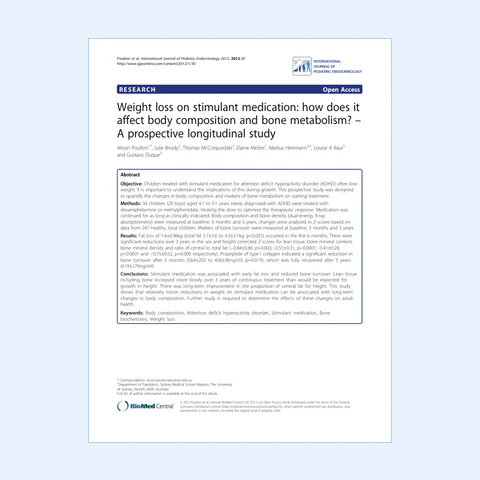
Weight loss on stimulant medication: how does it affect body composition and bone metabolism? – A prospective longitudinal study
34 newly diagnosed children were treated with stimulant medication for ADHD. The initial appetite suppression was associated with fat loss and reduced bone turnover. Central body fat, lean tissue and bone increased more slowly over 3 years of treatment than would be expected for growth…
-
Growth on stimulant medication; clarifying the confusion: a review
We reviewed 29 studies of growth in height in children with ADHD treated with stimulant medication. 11 of these were of poor quality and did not detect any slowing of growth. The studies with more rigorous design showed a deficit amounting to approximately 1 cm/year…
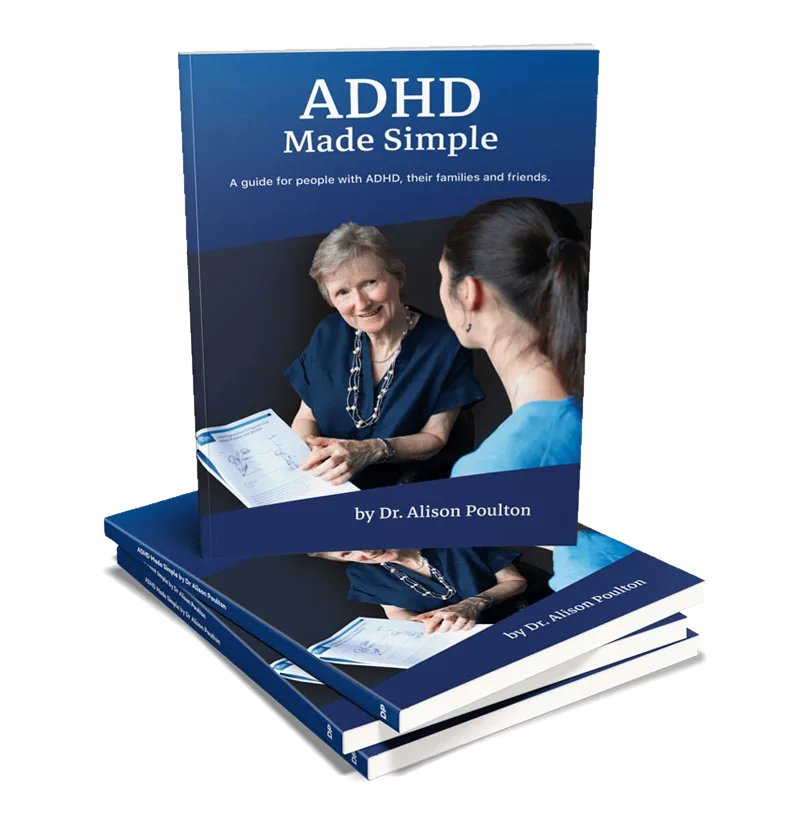
Dr. Poulton’s book
ADHD Made Simple
A guide for people with ADHD, their families and friends.
ADHD Made Simple is for anyone who has been diagnosed with ADHD as well as those who only suspect they may have it. It’s also for those people – parents, siblings, partners, children, colleagues – who love, care for or work with someone who has a diagnosis or characteristics of ADHD.
As someone who has, for over three decades, followed the large and complex research literature on ADHD, I know first-hand how difficult it is to distil that knowledge in a simple yet accurate manner. Dr. Poulton’s new book shows that she has achieved that goal.
Professor Stephen V. Faraone, PhD
President, World Federation of ADHD
ADHD Made Simple is a great book for anyone wanting to learn more about ADHD in easy-to-understand terms. It is refreshing to see a doctor providing useful information without using complex medical terminology.
Paula Burgess
Coach and author