For general practitioners
ADHD care for GPs
The five papers written for general practitioners, newest first, and the titration schedule they use — the resources are free to download.
Papers
Five papers for GPs
The 2026 cohort study of GP-led care and its practical companion, the 2024 pilot that came before them, and the two guides to assessing and recognising ADHD in a child.
-
New model of management of attention deficit hyperactivity disorder by trained general practitioners: Prospective cohort study in 207 children
This was a clinical study in which general practitioners were given training to diagnose and manage ADHD in children. We report on the first 207 children aged 4 to 17 managed through the programme. Families were seen far sooner than on a specialist waiting list, and teachers rated the children’s symptoms as much improved once treatment was established. It shows…
-
ADHD in children – practical clinical pearls for GPs
A practical guide for general practitioners to assessing and supporting a child who may have ADHD: looking for functional impairment at home, at school and beyond; picking up associated conditions such as learning difficulties, anxiety, sleep problems and tics; and monitoring medication using rating scales and reports from school and checking blood pressure, heart rate and growth.
-
Empowering general practitioners to diagnose and treat attention-deficit/hyperactivity disorder: Insights from an Australian pilot program
A short report on our pilot program training general practitioners to diagnose and treat ADHD in children, with specialist back-up. It describes how the programme was set up and some GP reflections on their experience of treating ADHD in general practice.
-
ADHD in children – what the GP can do
Treating ADHD usually involves a specialist, but there is a great deal a general practitioner can do first. This article for GPs covers how to assess a child with features of inattention, hyperactivity or impulsivity — is the behaviour out of proportion to their age, and is it causing harm? — and what can be put in place while the…
-
Recognising attention deficit hyperactivity disorder across the lifespan
ADHD affects about one child in ten and one adult in twenty, and general practitioners are often the first to see it — or to miss it. This review describes how ADHD evolves at the different stages of life, from the preschool child to the undiagnosed adult, to help GPs to recognise it. Timely treatment can make an enormous difference…
Webinar
ADHD Pathways – Management of ADHD in General Practice
For further information on GP prescribing, please refer to the webinar recorded by the PHN on 24/7/2024.
Clinical tools
The forms the papers use
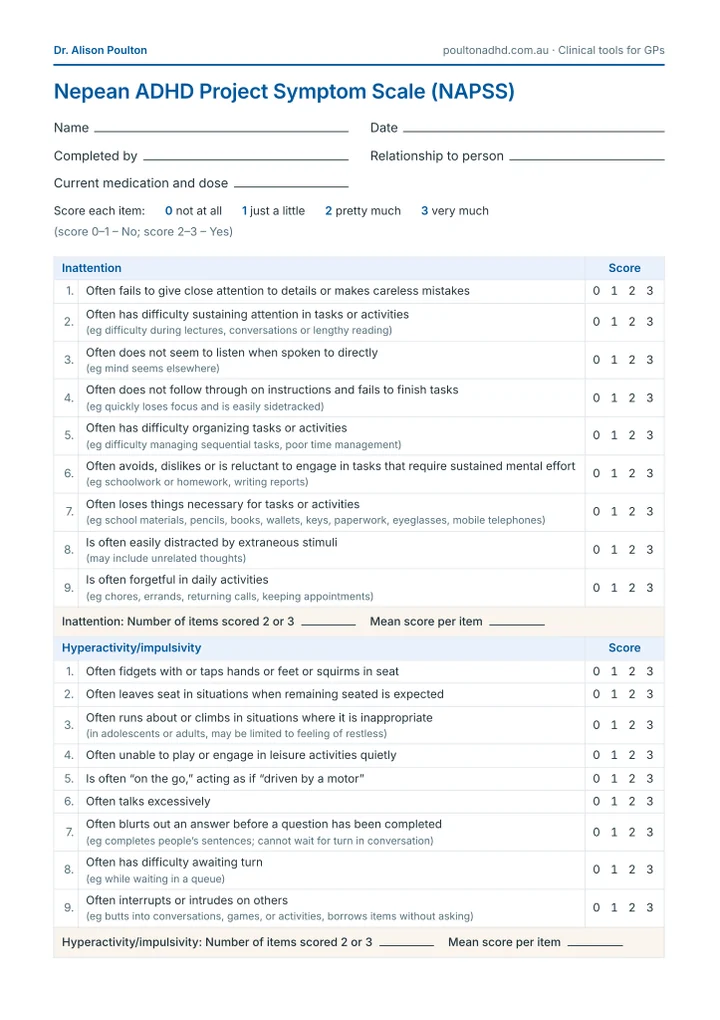
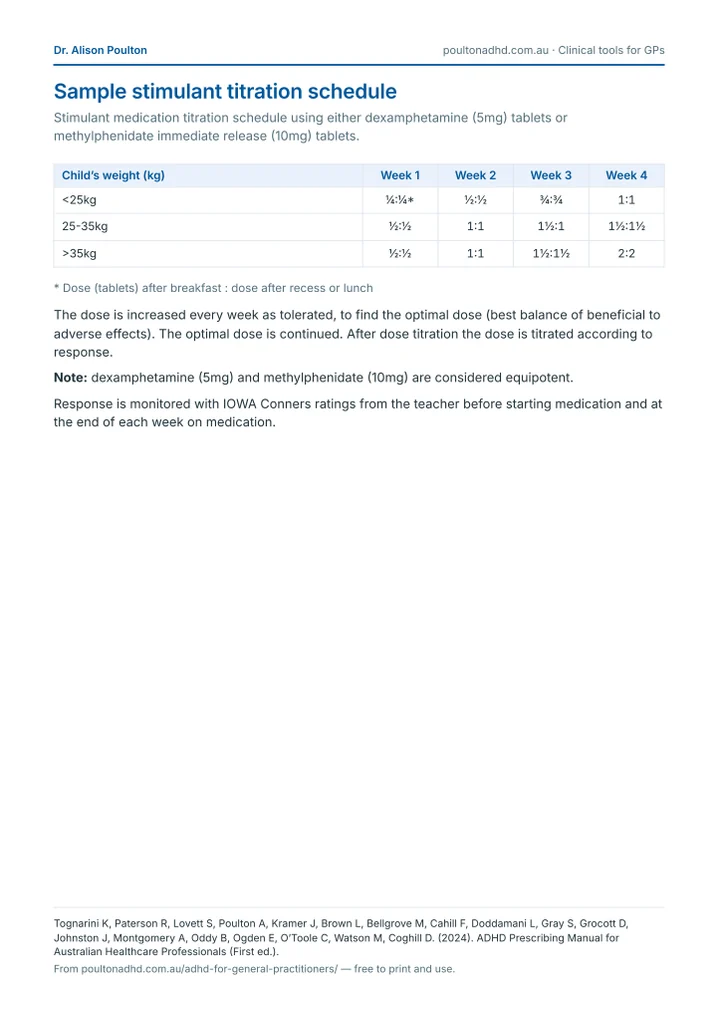
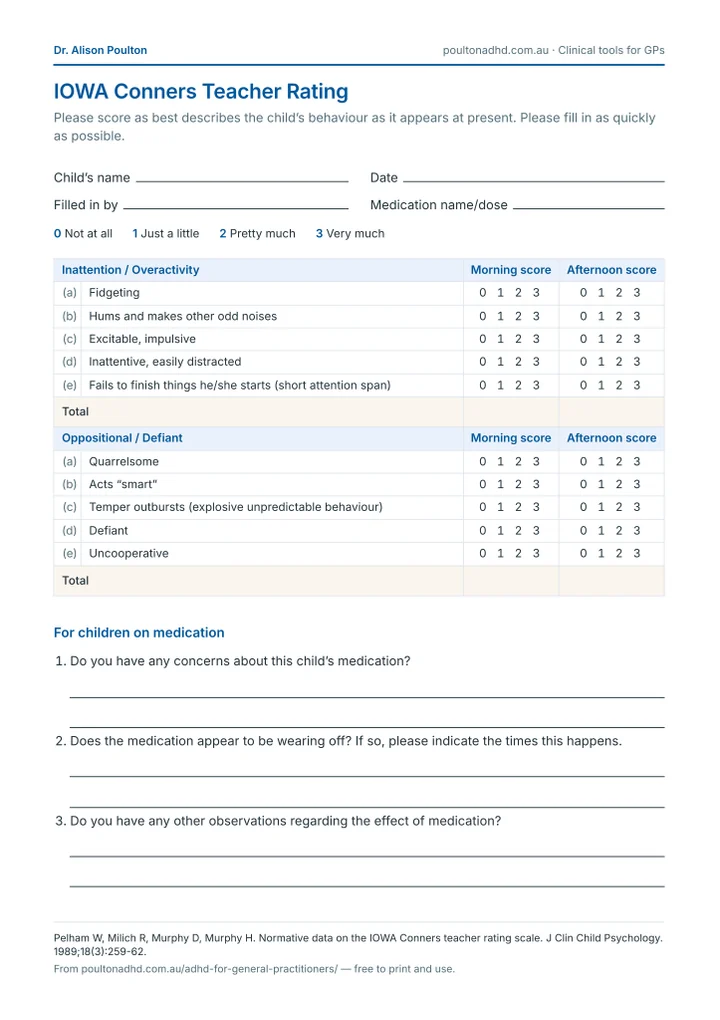
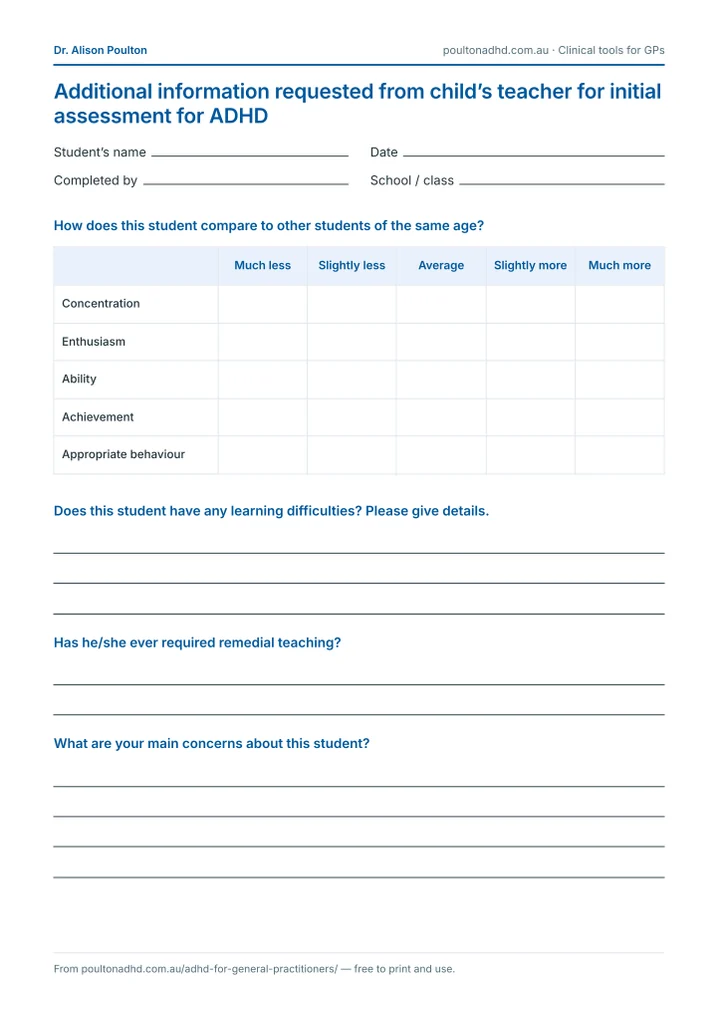
The four appendices of the 2026 AJGP paper — the symptom scale, the titration schedule, the IOWA Conners teacher rating and the teacher request — as A4 PDFs, as used in the Nepean ADHD Project. The IOWA Conners is also the monitoring scale of the 2024 pilot. Print them as they are.
-
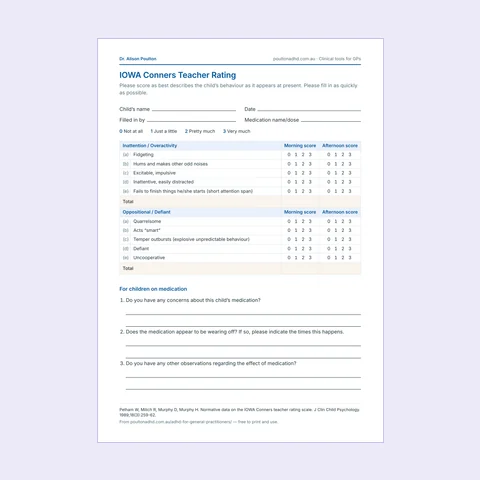
IOWA Conners Teacher Rating
A one-page rating scale for the child’s teacher — five inattention/overactivity items and five oppositional/defiant items, scored 0–3 for the morning and the afternoon, with three questions on medication. The scale of Pelham et al. (1989); Appendix 3 to the 2026 AJGP paper, and the monitoring scale of the 2024 pilot — completed before medication starts and at the end of each week of titration.
Used in AJGP 2026 · Medicine Today 2026 · JPCH 2024 · Medicine Today 2022
-
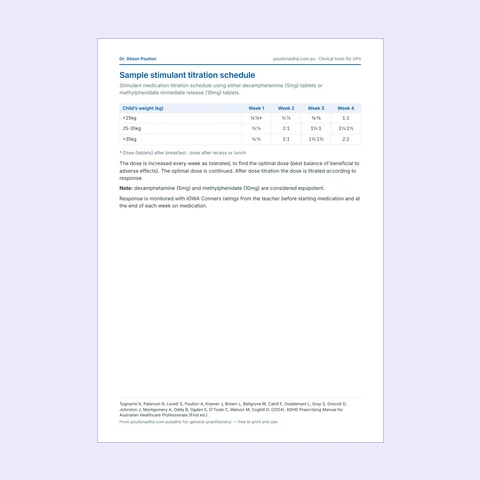
Sample stimulant titration schedule
A weight-banded schedule for starting dexamphetamine 5mg or methylphenidate IR 10mg tablets — the dose after breakfast and after lunch, stepped up each week over four weeks to find the optimal dose. Appendix 2 to the 2026 AJGP paper; from the ADHD Prescribing Manual for Australian Healthcare Professionals (Tognarini et al., 2024).
Used in AJGP 2026
-
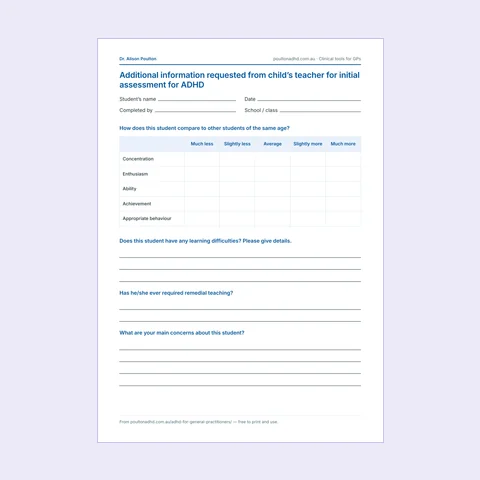
Additional information requested from the teacher
A one-page request to the child’s teacher for the initial assessment — how the student compares with classmates on concentration, enthusiasm, ability, achievement and behaviour, any learning difficulties or remedial teaching, and the teacher’s main concerns. The teacher questionnaire of the 2026 AJGP paper.
Used in AJGP 2026 · Medicine Today 2026 · Medicine Today 2022
-
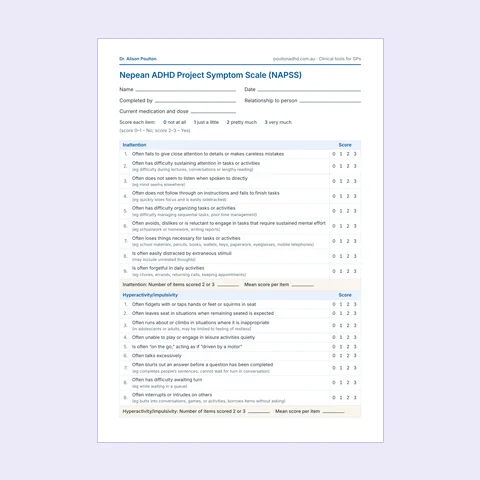
Nepean ADHD Project Symptom Scale (NAPSS)
The two-page symptom scale from the Nepean ADHD Project, updated 2026 — the DSM-5 items for inattention, hyperactivity/impulsivity and oppositional defiant disorder scored 0–3, each with a count of items scored 2 or 3 and a mean, plus five questions on impact. Appendix 1 to the 2026 AJGP paper.
Used in AJGP 2026 · Medicine Today 2026
Beyond the five papers
The research behind the GP training programme — the survey of what GPs know and want, and the prescribing data that shows where the system is stuck — sits with everything else on the topic. The explanation sheets are written for families, and many GPs hand them out.