In brief
We surveyed 162 caregivers of children attending paediatric services in Western Sydney, asking them the six-question adult ADHD screener and about adverse childhood experiences in their child. Caregivers with higher ADHD screening scores were about twice as likely to report four or more adverse experiences for their child (35% compared with 17%), and the link was strongest where the caregiver also reported anger or irritability. This suggests that families with caregivers who have symptoms of ADHD may need more support.
Abstract
Aim
To examine associations between caregiver ASRS-5 summed item scores, caregiver-reported anger/irritability and adverse childhood experiences (ACEs) reported for their children.
Methods
A cross-sectional, anonymous online survey (February 2022–March 2025). Adults who identified as the caregiver of a child were recruited through posters and QR codes through paediatric inpatient, outpatient, community and developmental services in Western Sydney. Caregiver ASRS-5 responses were summed (range 0–24); ≥ 14 was defined as a higher ASRS score. Caregivers also completed an ACE checklist.
Results
Among 162 caregivers (mean age 36.8 years, SD 8.5; 84.2% mothers/maternal figures), 66 (40.7%) had an ASRS-5 summed item score ≥ 14. An ACE score ≥ 4 was reported for 35% of children of these caregivers versus 17% of the remainder (OR 2.7; p = 0.012). Compared with caregivers ASRS-5 scoring 0–9, the adjusted odds of child ACE burden ≥ 4 were higher among those scoring 10–19 (OR 2.7, 95% CI 1.00–7.10) and ≥ 20 (OR 6.7, 95% CI 1.82–24.67). Each additional ACE was associated with a 0.45-point higher ASRS-5 summed item score (p < 0.001). Anger/irritability was associated with ACE burden ≥ 4 (OR 2.25, 95% CI 1.11–4.56), and exploratory stratified analyses showed an association between ASRS-5 summed item score and ACE score only in the higher anger/irritability stratum (p = 0.020).
Conclusions
In this self-selected sample, higher caregiver ASRS-5 item sums were associated with greater caregiver-reported ACE burden in their children. Further research should evaluate whether caregiver ASRS-5 response patterns and anger/irritability have potential utility in family-centred support.
Key Points
What is already known on this topic
- ACEs are associated with adverse mental health, developmental, and educational outcomes.
- ADHD-related difficulties in adult caregivers may affect organisation, parenting consistency, and family functioning.
- Direct evidence linking caregiver ASRS-5 item responses with ACE burden reported for their children is limited.
What this paper adds
- In a self-selected sample attending paediatric healthcare settings, a higher caregiver ASRS-5 item sum was statistically associated with greater caregiver-reported child ACE burden ≥ 4, with an approximately two-fold higher prevalence of ACE scores ≥ 4 among children of parents with a higher ASRS score ≥ 14. In detail, an ACE score ≥ 4 was reported for 35% of children of parents in the higher ASRS score group and 17% of those with lower scores.
- Exploratory stratified analyses suggested that the association between caregiver ASRS-5 summed item scores and child ACE scores was more apparent among caregivers reporting higher anger/irritability.
Introduction
The Australian Child Maltreatment Study has demonstrated that child maltreatment is common and is associated with substantial long-term mental health and behavioural consequences1. A recent meta-analysis of 65 studies estimated that 58% of children had been exposed to at least one ACE and 15% to four or more2. Similar findings have been reported in large international population studies3,4. Greater cumulative ACE exposure is associated with emotional and behavioural difficulties, poorer academic performance, and increased risk of mental health disorders during adolescence and adulthood5,6.
In Australia, the National Children’s Mental Health and Wellbeing Strategy emphasises family-centred assessment, early recognition of psychosocial risk, and prevention of intergenerational adversity7, while the Future Healthy Countdown 2030 identifies being “valued, loved and safe” as a core determinant of child and adolescent wellbeing8. Within Western Sydney, regional reports describe socioeconomic disadvantage, a substantial mental health burden, and inequitable access to care9,10. However, population and policy data may not be representative of families attending paediatric hospital and developmental services, whose healthcare needs and patterns of service use may differ from those of the general population.
Attention deficit hyperactivity disorder is a neurodevelopmental condition affecting ~8% of children and adolescents worldwide11, and symptoms and functional difficulties may persist into adulthood. The prevalence of ADHD in Australian adults is estimated at 2%–6%11–13, with 6.2% of middle-aged adults screening positive on the WHO Adult ADHD Self-Report Scale14. Adults with ADHD may experience difficulties with sustained attention, organisation, executive functioning, and emotion regulation, affecting occupational performance, interpersonal relationships, and family life15,16. When such difficulties are present in parents or primary caregivers, they may contribute to inconsistent discipline, reduced supervision, household disorganisation, and family conflict; subclinical ADHD traits may also impair parenting and increase family stress17.
Despite plausible connections, the link between parental ADHD and ACE exposure in their children remains underexplored. Most research has focused on ACEs of children diagnosed with ADHD or with parents’ mental health more broadly6,18,19. Comparatively little research has directly examined whether caregivers’ responses to adult ADHD screening items are associated with cumulative ACE exposure reported for their children. This question is particularly relevant in paediatric healthcare settings, given the heritability of neurodevelopmental or mental health difficulties and associated psychosocial stressors. Australian research has supported the potential utility of ACE checklists in paediatric settings20, while also emphasising that such tools should not be used as stand-alone diagnostic measures or determinants of service eligibility21.
The present study examined whether higher caregiver summed scores on the six-item ASRS-5 were associated with greater caregiver-reported ACE exposure in their children within a self-selected, healthcare-attending Western Sydney sample. It also explored whether this association differed according to caregiver self-reported anger/irritability. We hypothesised that higher caregiver ASRS-5 item-sum scores would be associated with greater cumulative ACE exposure in children, and that this association would be more pronounced among caregivers reporting higher anger/irritability.
Methods
Study Design
We conducted a cross-sectional, anonymous online survey from February 2022 to March 2025 using a convenience sample of families attending the Western Sydney hospital network. Participants were recruited through posters displayed in inpatient wards, outpatient clinics, and community-based sites affiliated with the paediatric healthcare network. Eligible respondents were adults who identified themselves as the primary caregiver of a child. Participation was based on self-selection, and all measures were self-reported. No missing data were noted as the online survey required a response to each item before participants could finalise the survey.
Caregiver ADHD symptoms were assessed using the six-item DSM-5 ASRS-5 self-report scale for adult ADHD22. Each item was rated on a 0–4 scale (never, rarely, sometimes, often, very often), yielding a total score from 0 to 24. A summed score of ≥ 14 was defined as a higher ASRS score. A summed ASRS-5 item score of ≥ 14 was used as a study-defined analytical cut-off for group comparisons. Although this score corresponds to the published ASRS-5 screening threshold22, in the present study it was used only as an analytical categorisation and should not be interpreted as a diagnosis of ADHD, a validated screening result, or a measure of symptom severity. Child ACE exposure was measured with the ACE checklist, and high ACE burden was defined a priori as four or more ACEs20,23. Caregiver anger/irritability was assessed using a study-specific question, “How often do you become angry or easily irritated by minor frustrations?” This single item was not a validated measure of oppositional defiant disorder or emotional dysregulation. For descriptive analyses, responses of “often” or “very often” were labelled higher anger/irritability, while “never”, “rarely”, or “sometimes” were labelled lower anger/irritability.
Statistical Analysis
The unweighted ASRS-5 summed item score was modelled as a continuous variable and in study-defined categories: 0–9 (88/162, 54.3%), 10–19 (70/162, 43.2%), and ≥ 20 (4/162, 2.5%). These categories were selected to be roughly equal according to the observed distribution and interpretability and are not validated clinical cut-offs. The study-defined higher ASRS score (≥ 14) was used for secondary group comparisons. Associations with child ACE burden were examined using logistic regression with standard errors and adjustment for age and sex of caregiver and child. Ordinary least-squares regression assessed the association between continuous child ACE total and the caregiver item sum. Item-level associations were examined using categorical comparisons and ordinal logistic regression, and stratified linear regressions explored patterns according to caregiver-reported anger/irritability. No formal interaction term was fitted; therefore, stratum-specific p-values were not interpreted as a statistical test of effect modification. Two-sided p < 0.05 was considered statistically significant. Analyses were performed using Stata Statistical Software, version 18.
Ethics approval was obtained from Nepean Blue Mountains Local Health District Human Research Ethics Committee (HREC) (Ethics approval number: 2022/STE00364). As the study involved anonymous survey data, the requirement for written consent was waived.
Results
A total of 162 caregivers were included (mean age 36.8 years, SD 8.5). Most were mothers or maternal figures (84.2%) (Table 1). Educational attainment included completion up to year 12 in 36%, VET/TAFE qualifications in 25%, and a university or higher degree in 39%. Regarding other children in the family, 22.6% had none, 43.4% had one, 20.8% had two, and 13.2% had three or more. The mean child age was 7.3 years (SD 4.6); 42% were aged 0–5 years, 46% were aged 6–12 years, and 12% were aged 13–18 years. Children were 53% male and 47% female. Approximately two-thirds of households included two adults (64%). Sixty-six caregivers (41%) met the study-defined higher ASRS score ≥ 14, 53% reported ADHD in a family or household member, and 50% reported another mental health condition in the family or household.
| Characteristics | n | % | |
|---|---|---|---|
| Caregiver relationship | Mother or maternal figure | 133 | 84.2 |
| Father | 25 | 15.8 | |
| Carer age (years), mean (SD) | 36.8 (8.5) | ||
| Caregiver ASRS-5 summed item score mean (SD) | 9.2 (5.1) | ||
| Study-defined higher ASRS score (≥ 14) | 66 | 40.7 | |
| Number of adults in family | Single parents | 33 | 20.8 |
| 2 adults | 102 | 64.2 | |
| > 2 adults | 24 | 15.1 | |
| Education | Up to Year 12 | 59 | 36 |
| VET/TAFE | 40 | 25 | |
| University or higher | 63 | 39 | |
| Number of other children in family | 0 | 36 | 22.6 |
| 1 | 69 | 43.4 | |
| 2 | 33 | 20.8 | |
| ≥ 3 | 21 | 13.2 | |
| Gender of child | Male | 85 | 53.1 |
| Female | 75 | 46.9 | |
| Child age (years), mean (SD) | 7.3 (4.6) | ||
| Child age (years) | Preschool (0–5) | 66 | 41.5 |
| Primary school (6–12) | 74 | 46.5 | |
| High school (13–18) | 19 | 11.9 | |
| ADHD in family/household | 85 | 53.1 | |
| Other mental health condition in family/household (not including ADHD) | 81 | 50.3 |
Abbreviations: TAFE, Technical and Further Education; VET, Vocational Education and Training.
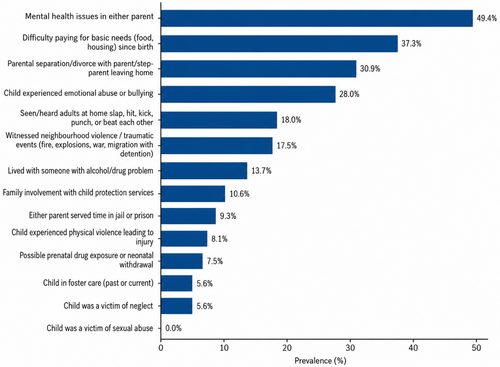
Overall, 115 children (71%) were reported to have experienced at least one ACE (Figure 1). Parental mental health problems were the most commonly reported adversity (50%), including depression, anxiety disorders, obsessive-compulsive disorder, schizophrenia, and bipolar disorder. Around one-third of children were exposed to financial hardship, parental separation or divorce, or emotional abuse/bullying. About one-fifth were exposed to domestic violence or other traumatic events. Other adversities reported in 10%–15% included household substance use, child protection involvement or parental incarceration (9.3%). Less frequently reported exposures included physical violence towards the child, prenatal drug exposure, neglect, or being raised in foster care.
As shown in Table 2, an ACE score ≥ 4 was reported for 35% of children whose caregiver met the study-defined higher ASRS score ≥ 14 and 17% whose caregiver did not (RR 2.1; OR 2.7; p = 0.012) (mean ACE scores 3.33 (SD 2.90) and 1.74 (SD 2.26), respectively, p < 0.001). The point-biserial correlation between the study-defined higher ASRS score ≥ 14 and child ACE score was r = 0.29 (p < 0.001). These are statistical associations based on a study-defined classification and do not represent validated caregiver ADHD status.
| Caregiver ASRS-5 summed item score | N (%) | OR | 95% CI | p |
|---|---|---|---|---|
| 0–9 (reference) | 88 (54.3%) | 1.0 | — | — |
| 10–19 | 70 (43.2%) | 2.7 | 1.00–7.10 | 0.041 |
| ≥ 20 | 4 (2.5%) | 6.7 | 1.82–24.67 | < 0.001 |
Note: Adjusted for caregiver and child age and sex.
Abbreviations: CI, confidence interval; OR, odds ratio.
In multivariable logistic regression, the odds of child ACE burden ≥ 4 increased across study-defined caregiver ASRS summed item scores. Compared with an item sum of 0–9, the adjusted odds ratio was 2.7 (95% CI 1.00–7.10; p = 0.041) for item sums of 10–19 and 6.7 (95% CI 1.82–24.67; p < 0.001) for item sums ≥ 20 (Table 2). These categories are not validated clinical cut-offs, and the graded pattern should not be interpreted as a clinical dose–response relationship.
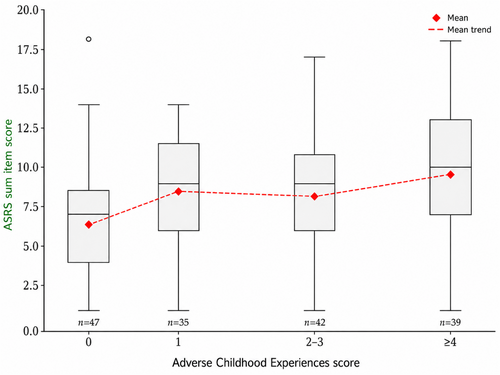
Consistent with these findings, Figure 2 shows the distribution of the caregiver ASRS-5 summed item score across child ACE categories. In an ordinary least-squares model with the caregiver ASRS summed item score as the outcome, each additional reported ACE was associated with a 0.45-point higher ASRS summed item score (β = 0.45; p < 0.001; R2 = 0.09).
At the item level, the distribution of responses to the question about difficulty concentrating on what people say during direct conversation, analysed as a continuous variable, differed between the ACE 0–3 and ACE ≥ 4 groups (p = 0.005) (Table 3). In ordinal logistic regression, caregivers of children with ACE ≥ 4 had higher odds of responding either “often” or “very often” to this item (OR 2.49, 95% CI 1.25–4.96; p = 0.009). The distribution of responses to the study-specific anger/irritability item differed between ACE 0–3 and ACE ≥ 4 groups (p = 0.002). In ordinal logistic regression, caregivers of children with ACE ≥ 4 had higher odds of responding either “often” or “very often” to this item (OR 2.25, 95% CI 1.11–4.56; p = 0.024). The single anger/irritability item is not a validated assessment of oppositional defiant disorder or emotional dysregulation.
| Sample (n = 162) | ACE 0–3 | ACE ≥ 4 | p | |
|---|---|---|---|---|
| N = 123 | N = 39 | |||
| Six ASRS-5 items reported by the caregiver | ||||
| N (%) | N (%) | |||
| 1. How often do you have difficulty concentrating on what people say to you, even when they are speaking to you directly?a | Never | 24 (19.5) | 6 (15.4) | 0.005 |
| Rarely | 40 (32.5) | 7 (17.9) | ||
| Sometimes | 42 (34.1) | 13 (33.3) | ||
| Often | 16 (13.0) | 8 (20.5) | ||
| Very Often | 1 (0.8) | 5 (12.8) | ||
| 2. How often do you leave your seat in meetings or other situations in which you are expected to remain seated? | Never | 64 (52.0) | 14 (35.9) | 0.16 |
| Rarely | 42 (34.1) | 14 (35.9) | ||
| Sometimes | 13 (10.6) | 7 (17.9) | ||
| Often | 2 (1.6) | 3 (7.7) | ||
| Very Often | 2 (1.6) | 1 (2.6) | ||
| 3. How often do you have difficulty unwinding and relaxing when you have time to yourself? | Never | 24 (19.5) | 5 (12.8) | 0.75 |
| Rarely | 19 (15.4) | 6 (15.4) | ||
| Sometimes | 39 (31.7) | 11 (28.2) | ||
| Often | 24 (19.5) | 9 (23.1) | ||
| Very Often | 17 (13.8) | 8 (20.5) | ||
| 4. When you’re in a conversation, how often do you find yourself finishing the sentences of the people you are talking to before they can finish them themselves? | Never | 28 (22.8) | 5 (12.8) | 0.09 |
| Rarely | 34 (27.6) | 5 (12.8) | ||
| Sometimes | 40 (32.5) | 17 (43.6) | ||
| Often | 13 (10.6) | 7 (17.9) | ||
| Very Often | 8 (6.5) | 5 (12.8) | ||
| 5. How often do you put things off until the last minute? | Never | 14 (11.4) | 4 (10.3) | 0.14 |
| Rarely | 30 (24.4) | 4 (10.3) | ||
| Sometimes | 36 (29.3) | 9 (23.1) | ||
| Often | 25 (20.3) | 14 (35.9) | ||
| Very Often | 18 (14.6) | 8 (20.5) | ||
| 6. How often do you depend on others to keep your life in order and attend to details? | Never | 47 (38.2) | 13 (33.3) | 0.08 |
| Rarely | 45 (36.6) | 10 (25.6) | ||
| Sometimes | 18 (14.6) | 5 (12.8) | ||
| Often | 11 (8.9) | 8 (20.5) | ||
| Very Often | 2 (1.6) | 3 (7.7) | ||
| Study-specific caregiver anger/irritability item | ||||
| How often do you get angry or easily irritated by minor frustrations?b | Never | 11 (8.9) | 5 (12.8) | 0.002 |
| Rarely | 31 (25.2) | 6 (15.4) | ||
| Sometimes | 58 (47.2) | 9 (23.1) | ||
| Often | 18 (14.6) | 17 (43.6) | ||
| Very Often | 5 (4.1) | 2 (5.1) | ||
a Ordinal logistic regression: ACE ≥ 4, ACE 0–3 (OR 2.49, 95% CI 1.25–4.96; p = 0.009).
b Ordinal logistic regression showed that caregivers of children with ACE ≥ 4 had higher odds of reporting higher anger/irritability than caregivers of children with ACE 0–3 (OR 2.25, 95% CI 1.11–4.56; p = 0.024).
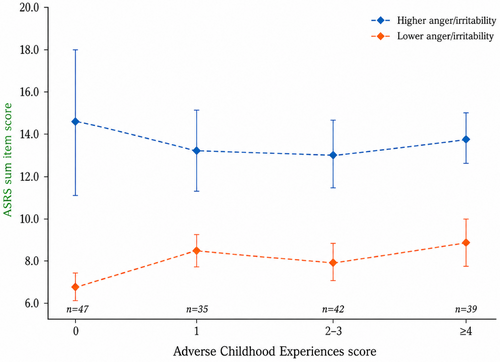
Finally, stratified analyses suggested that the association appeared stronger among caregivers reporting higher anger/irritability (β = 0.27 per additional ACE; p = 0.020), but not among caregivers reporting lower anger/irritability (β = 0.15; p = 0.30) (Figure 3). These findings indicate that the relationship between carer-reported ASRS-5 score and offspring ACE burden was stronger in the presence of higher anger/irritability. However, these findings should be considered exploratory and should not be interpreted as evidence of effect modification.
Discussion
In this self-selected sample of caregivers attending paediatric health services, higher ASRS-5 summed item scores were statistically associated with a greater likelihood of caregiver-reported ACE burden ≥ 4 in their children. The item concerning difficulty concentrating during direct conversation and the study-specific anger/irritability item were more strongly associated with an ACE burden ≥ 4. Previous research has linked parental emotional dysregulation and ADHD-related difficulties with harsh or inconsistent parenting, greater family stress, and household chaos16,24. However, the present study used an unvalidated anger/irritability item, did not diagnose oppositional defiant disorder, and did not formally test an interaction. The findings should therefore be considered hypothesis-generating. The observed stratified pattern is compatible with the hypothesis that caregiver anger/irritability contributes to the association between caregiver ADHD-related difficulties and childhood adversity, but it does not establish this mechanism.
Most previous research has examined ACE exposure as a potential antecedent of ADHD in the same child or individual, rather than caregiver ADHD symptoms as the exposure and ACEs in their children as the outcome. Brown et al. reported a graded association between cumulative ACE burden and child ADHD diagnosis and symptom severity in the US National Survey of Children’s Health19. A systematic review and meta-analysis indicated that ACE exposure (particularly multiple ACEs) was associated with subsequent ADHD in adulthood (OR 1.68, 95% CI 1.54–1.83)6. These studies provide background evidence about ACE–ADHD relationships but do not directly validate the caregiver-focused association or the study-defined scoring used here.
The recruited sample comprised predominantly mothers or maternal figures and had a relatively high reported prevalence of ADHD and/or other mental health conditions in the family or household and should not be considered representative of Western Sydney or Australia. Families experiencing cumulative adversity may be more likely to attend hospital or specialist services, while caregivers attending paediatric or developmental services may be more familiar with ADHD-related symptoms and more likely to recognise or report them. Both mechanisms could increase the reported ACE burden and caregiver ASRS-5 score.
The ACE checklist used in this study was adapted for use in Southern Sydney, where it was considered a simple and acceptable clinical indicator that may improve identification of vulnerable children and inform service development20. However, a systematic review concluded that ACE tools may support trauma-informed care but should not be used as stand-alone diagnostic instruments or to determine service eligibility, and that implementation requires training, safeguards, and follow-up support21.
Family-centred, multi-component approaches are recommended for responding to adversity-related risk, and World Health Organisation guidance supports evidence-based parenting interventions to reduce maltreatment and harsh parenting, strengthen parent–child relationships, and improve parent mental health, particularly for families experiencing mental health difficulties or high stress18. We suggest that the present findings may provide preliminary evidence that caregiver-level factors warrant consideration in further family-focused research. They do not, however, demonstrate that routine caregiver ASRS-5 or anger/irritability screening is effective, clinically useful, or appropriate for universal implementation.
The relationship to Australian policy is conceptual rather than evaluative. The Australian Child Maltreatment Study documents the substantial burden of child maltreatment and its association with later mental disorders and health-risk behaviours1. The Future Healthy Countdown 2030 framework identifies being “valued, loved and safe” as a core determinant of child and adolescent wellbeing8, while the National Children’s Mental Health and Wellbeing Strategy emphasises family-centred assessment, recognition of family-level psychosocial risk, trauma-informed care, early support, and prevention of intergenerational adversity7. The current study is relevant to these priorities because it examines caregiver-level factors alongside child adversity; however, it does not test, validate, or demonstrate the effectiveness of any policy or screening programme.
Several limitations should be acknowledged. This was a self-selected, healthcare-attending convenience sample recruited from paediatric services. The number of people exposed to the open invitation was unknown, so a response rate could not be calculated. Families with greater adversity may be more likely to attend hospital or specialist services, creating selection and ascertainment bias. The children’s primary diagnoses and reasons for attendance were not collected, although these factors may be associated with caregiver stress, ACE exposure, and healthcare use. Anger/irritability should not be interpreted as a validated measure of oppositional defiant disorder or emotional dysregulation generally. All variables were reported by the same caregiver, increasing the possibility of common-method and reporting bias. The ACE checklist does not capture the severity, timing, or chronicity of adverse experiences. Residual confounding is likely, and the cross-sectional design precludes causal inference. Longitudinal studies using validated scoring, diagnostic assessments, multiple informants, and more representative samples are required.
Conclusion
Within this self-selected healthcare-attending sample, higher caregiver ASRS-5 summed item scores, particularly in the presence of higher self-reported anger/irritability, were associated with greater caregiver-reported ACE burden in children. These findings should be interpreted cautiously given the cross-sectional design, self-selected sample, reliance on caregiver-reported data, and the use of study-defined scoring approaches. The observed association warrants further investigation in longitudinal studies using validated assessments but should be considered hypothesis-generating and does not establish the clinical utility of caregiver ADHD screening.
References
- B. Mathews, “The Australian Child Maltreatment Study: National Prevalence and Associated Health Outcomes of Child Abuse and Neglect,” Medical Journal of Australia 218, no. 6 (2023): S1–S51.
- S. Madigan, R. Thiemann, A.-A. Deneault, et al., “Prevalence of Adverse Childhood Experiences in Child Population Samples: A Systematic Review and Meta-Analysis,” JAMA Pediatrics 179, no. 1 (2025): 19–33. 10.1001/jamapediatrics.2024.4385PubMed Web of Science®
- C. A. Nelson, Z. A. Bhutta, N. B. Harris, A. Danese, and M. Samara, “Adversity in Childhood Is Linked to Mental and Physical Health Throughout Life,” BMJ 371 (2020): m3048. 10.1136/bmj.m3048
- K. Hughes, M. A. Bellis, K. A. Hardcastle, et al., “The Effect of Multiple Adverse Childhood Experiences on Health: A Systematic Review and Meta-Analysis,” Lancet Public Health 2, no. 8 (2017): e356–e366. 10.1016/S2468-2667(17)30118-4PubMed Web of Science®
- G. Qu, L. Shu, H. Liu, et al., “Association Between Adverse Childhood Experiences and Academic Performance Among Children and Adolescents: A Global Meta-Analysis,” Trauma, Violence & Abuse 25, no. 4 (2024): 3332–3345. 10.1177/15248380241246758PubMed Web of Science®
- N. Zhang, M. Gao, J. Yu, et al., “Understanding the Association Between Adverse Childhood Experiences and Subsequent Attention Deficit Hyperactivity Disorder: A Systematic Review and Meta-Analysis of Observational Studies,” Brain and Behavior 12, no. 10 (2022): e32748. 10.1002/brb3.2748PubMed Web of Science®
- Commission NMH, The National Children’s Mental Health and Wellbeing Strategy (National Mental Health Commission, 2021).
- S. Demaio, S. R. Goldfeld, A. Hollonds, et al., “The Future Healthy Countdown 2030: Holding Australia to Account for the Health and Wellbeing of Future Generations,” Medical Journal of Australia 217, no. 9 (2022): 484–485. 10.5694/mja2.51746PubMed Web of Science®
- W. MHCoNS, ed., Western Sydney Regional Profile (Mental Health Commission of NSW, 2020).
- Modelling NCfSaE, Mapping Mental Health Care: Research Summary (Mental Health Australia, 2023).
- G. Ayano, S. Demelash, Y. Gizachew, L. Tsegay, and R. Alati, “The Global Prevalence of Attention Deficit Hyperactivity Disorder in Children and Adolescents: An Umbrella Review of Meta-Analyses,” Journal of Affective Disorders 339 (2023): 860–866. 10.1016/j.jad.2023.07.071PubMed Web of Science®
- J. L. Ebejer, S. E. Medland, J. van der Werf, et al., “Attention Deficit Hyperactivity Disorder in Australian Adults: Prevalence, Persistence, Conduct Problems and Disadvantage,” PLoS One 7, no. 10 (2012): e47404. 10.1371/journal.pone.0047404CAS PubMed Web of Science®
- P. Song, M. Zha, Q. Yang, Y. Zhang, X. Li, and I. Rudan, “The Prevalence of Adult Attention-Deficit Hyperactivity Disorder: A Global Systematic Review and Meta-Analysis,” Journal of Global Health 11 (2021): 04009. 10.7189/jogh.11.04009PubMed Web of Science®
- D. Das, N. Cherbuin, P. Butterworth, K. J. Anstey, and S. Easteal, “A Population-Based Study of Attention Deficit/Hyperactivity Disorder Symptoms and Associated Impairment in Middle-Aged Adults,” PLoS One 7, no. 2 (2012): e31500. 10.1371/journal.pone.0031500CAS PubMed Web of Science®
- A. R. Kosheleff, O. Mason, R. Jain, J. Koch, and J. Rubin, “Functional Impairments Associated With ADHD in Adulthood and the Impact of Pharmacological Treatment,” Journal of Attention Disorders 27, no. 7 (2023): 669–697. 10.1177/10870547231158572PubMed Web of Science®
- P. Shaw, A. Stringaris, J. Nigg, and E. Leibenluft, “Emotion Dysregulation in Attention Deficit Hyperactivity Disorder,” American Journal of Psychiatry 171, no. 3 (2014): 276–293. 10.1176/appi.ajp.2013.13070966PubMed Web of Science®
- J. L. Park, K. L. Hudec, and C. Johnston, “Parental ADHD Symptoms and Parenting Behaviors: A Meta-Analytic Review,” Clinical Psychology Review 56 (2017): 25–39. 10.1016/j.cpr.2017.05.003PubMed Web of Science®
- Organization WH, WHO Guidelines on Parenting Interventions to Prevent Maltreatment and Enhance Parent–Child Relationships With Children Aged 0–17 Years (World Health Organization, 2022).
- N. M. Brown, S. N. Brown, R. D. Briggs, M. Germán, P. F. Belamarich, and S. O. Oyeku, “Associations Between Adverse Childhood Experiences and ADHD Diagnosis and Severity,” Academic Pediatrics 17, no. 4 (2017): 349–355. 10.1016/j.acap.2016.08.013PubMed Web of Science®
- Y. Wickramasinghe, S. Raman, P. Garg, K. Jain, and R. Hurwitz, “The Adverse Childhood Experiences Checklist: Can It Serve as a Clinical and Quality Indicator?,” Journal of Paediatrics and Child Health 55, no. 9 (2019): 1113–1118. 10.1111/jpc.14368PubMed Web of Science®
- S. Cibralic, M. Alam, A. M. Diaz, et al., “Utility of Screening for Adverse Childhood Experiences (ACE) in Children and Young People Attending Clinical and Healthcare Settings: A Systematic Review,” BMJ Open 12, no. 8 (2022): e060395. 10.1136/bmjopen-2021-060395PubMed Web of Science®
- B. Ustun, L. A. Adler, C. Rudin, et al., “The World Health Organisation Adult Attention-Deficit/Hyperactivity Disorder Self-Report Screening Scale for DSM-5,” JAMA Psychiatry 74, no. 5 (2017): 520–526. 10.1001/jamapsychiatry.2017.0298
- N. J. Burke, J. L. Hellman, B. G. Scott, C. F. Weems, and V. G. Carrion, “The Impact of Adverse Childhood Experiences on an Urban Pediatric Population,” Child Abuse & Neglect 35, no. 6 (2011): 408–413. 10.1016/j.chiabu.2011.02.006PubMed Web of Science®
- I. Mokrova, M. O’Brien, S. Calkins, and S. Keane, “Parental ADHD Symptomology and Ineffective Parenting: The Connecting Link of Home Chaos,” Parenting: Science and Practice 10, no. 2 (2010): 119–135. 10.1080/15295190903212844PubMed Web of Science®