In brief
Treating ADHD usually involves a specialist, but there is a great deal a general practitioner can do first. This article for GPs covers how to assess a child with features of inattention, hyperactivity or impulsivity — is the behaviour out of proportion to their age, and is it causing harm? — and what can be put in place while the family waits for a paediatric appointment.
Abstract
Although treatment of attention deficit hyperactivity disorder (ADHD) usually involves specialist input, the GP plays an important role in assessment and arranging nonpharmacological treatment while waiting for a paediatric appointment. Assessment of a child showing typical ADHD features of inattention, hyperactivity or impulsivity focuses on whether the behaviour is out of proportion to his or her developmental level and whether it is causing functional impairment.
What the article covers
ADHD is one of the commonest conditions of childhood — the article puts it at roughly 7 to 11 per cent of school-aged children — and it typically runs in families. It keeps company with other conditions: learning difficulties are common alongside it, and children born prematurely are more often affected. A GP who knows a family will often have seen the pattern before in a parent or a sibling.
The diagnosis is categorical — a child either meets the criteria or does not — but the features behind it are not. Inattention, restlessness and impulsivity are spread continuously through the population, and where a child sits on that spectrum matters less than whether the behaviour is out of proportion to their age and stage and whether it is doing harm at home, at school or with friends. That question of functional impairment is the heart of the assessment. ADHD is also lifelong: the symptoms do not go away, they change shape as a child grows, so the picture in a five-year-old and a fifteen-year-old can look quite different.
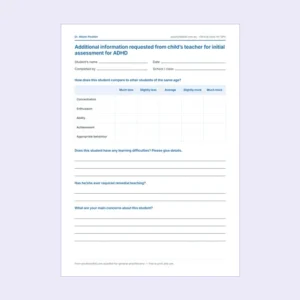
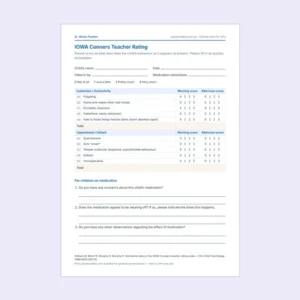
Most of the article is about what the GP can do before the paediatric appointment comes round. Assessment starts in the surgery: the history from the parents, the child’s development and health, and — because the classroom is where ADHD shows most clearly — a report from the school. From there the GP can put non-drug measures in place straight away: help for the family in understanding the condition, structure and behaviour strategies at home, and support at school for any learning difficulty that has come to light. None of it waits for a specialist, and all of it makes the eventual paediatric review more useful.
Who wrote it
Dr Alison Poulton is a Senior Lecturer in Paediatrics at Sydney Medical School Nepean, The University of Sydney. Associate Professor John Kramer is a general practitioner at Woolgoolga on the NSW north coast, a Conjoint Associate Professor of Medicine at UNSW Sydney, and Chair of the Royal Australian College of General Practitioners’ ADHD, ASD and Neurodiversity Specific Interest Group — so the article is written from both sides of the referral.
Read next
- The school report the article asks for: the request for information from the teacher and the IOWA Conners Teacher Rating, both printable PDFs.
- ADHD in children – practical clinical pearls for GPs (2026), the follow-up in the same series.
- All five papers for GPs and the clinical tools, on one page.