In brief
A practical guide for general practitioners to assessing and supporting a child who may have ADHD: looking for functional impairment at home, at school and beyond; picking up associated conditions such as learning difficulties, anxiety, sleep problems and tics; and monitoring medication using rating scales and reports from school and checking blood pressure, heart rate and growth.
Abstract
Attention deficit hyperactivity disorder is a common neurodevelopmental condition that can significantly affect academic, social and family functioning. GPs have an important role in early identification, assessment and support in the continuum of care. Optimal management is multimodal and individualised, combining pharmacological and nonpharmacological interventions, including parent and family training, psychological interventions, school-based support, lifestyle intervention and appropriate medication for children with significant functional impairment.
The five pearls
The article is built around five practical points for the consulting room. In plain language:
- Look at the whole child, in every setting. The question is not only whether the symptoms are there but whether they are getting in the way — at home, at school, and in sport, music and the other things the child does outside both.
- Expect company. ADHD rarely comes alone. Learning difficulties and other neurodevelopmental conditions, anxiety, low mood and trouble regulating emotion, poor sleep, eating difficulties, tics and — in older children — substance use all travel with it, and each needs to be found and dealt with on its own terms.
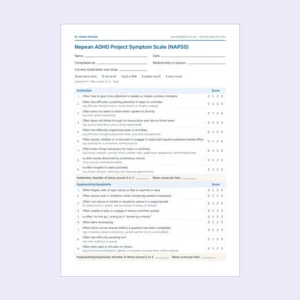
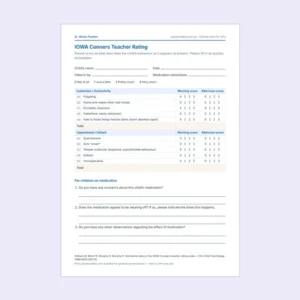
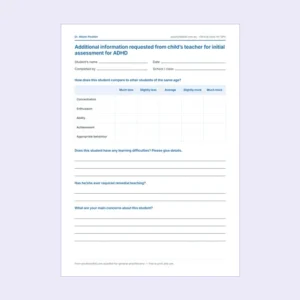
- Measure, and measure from more than one place. Validated rating scales, filled in by parents and by the school, give a baseline of symptoms and impairment to judge treatment against later. One informant is an opinion; two settings are evidence.
- Be the child’s advocate. A GP can ask the school for the adjustments a child is entitled to, and connect the family with the services and networks that will carry them between appointments.
- Keep watching the body. Once treatment starts, blood pressure, heart rate, height, weight and body mass index are measured and tracked, and any other physical concern is followed up as it arises.
What the article covers
The article opens by defining ADHD as a neurodevelopmental condition: a persistent pattern of inattention, hyperactivity or impulsivity that is out of keeping with the child’s developmental level and interferes with functioning in more than one setting. Its case for early recognition is what happens when the condition is missed or under-treated — academic failure, stress within the family, mental health problems layered on top, and poorer outcomes in work and relationships that reach well into adult life.
From there it walks a GP through a holistic assessment: functional impairment across home, school and extracurricular life; the comorbid conditions to screen for; the assessment tools and school reports that establish a baseline and then track response; and the physical health checks that go with medication. Management, the authors argue, is multimodal and individual — parent and family training, psychological support, adjustments at school, attention to sleep, diet and exercise, and medication for the children whose impairment is significant — with the GP placed at the centre of the continuum of care rather than at its edge.
It is the companion to ADHD in children – what the GP can do (2022), which set out the initial assessment and what to put in place while a family waits for a paediatrician; this article takes the story on through comorbidity, monitoring and advocacy.
Who wrote it
Dr Catherine McHugh is a Senior Lecturer in Psychiatry at UNSW Sydney. Dr Alison Poulton is a Senior Lecturer in Paediatrics at Sydney Medical School Nepean, The University of Sydney. Professor Valsamma Eapen is Scientia Professor and Chair of Infant, Child and Adolescent Psychiatry at UNSW Sydney, and Head of the Academic Unit of Child Psychiatry in the South Western Sydney Local Health District. Psychiatry and paediatrics on the same page, for the doctor who sees the child first.
Read next
- The rating scales and school reports the third pearl asks for, as printable PDFs: the Nepean ADHD Project Symptom Scale for parents and teachers, the IOWA Conners Teacher Rating for monitoring, and the request for information from the teacher.
- ADHD in children – what the GP can do (2022), the first article in the series.
- All five papers for GPs and the clinical tools, on one page.