In brief
A short report on our pilot program training general practitioners to diagnose and treat ADHD in children, with specialist back-up. It describes how the programme was set up and some GP reflections on their experience of treating ADHD in general practice.
As the number of Australians seeking treatment for attention-deficit/hyperactivity disorder (ADHD) has been steadily increasing,1 this has put increasing strain on the pathways to treatment. In 2023, the Australian Senate published a report on Assessment and support services for people with ADHD, noting the barriers to accessing assessment and treatment for ADHD.2 The government has yet to respond. A particular issue was the limited capacity and high costs of specialist treatment. These findings are consistent with the 2019 Henry Review,3 which identified a serious problem with access to ADHD services for young people in New South Wales.
The difficulties with accessing specialist treatment for ADHD are putting increased pressure on general practitioners (GPs). A recent survey of Australian GPs found that 92% had identified ADHD in one or more of their patients within the previous year,4 but inadequate access to specialists for diagnosis and treatment was a major concern.
In order to address this bottleneck, we are piloting a model of integrated care with upskilled GPs. Our model differs from the pilot study of integrated GP-paediatrician care by Hiscock and colleagues in Victoria.5 In that study, the paediatricians attended the individual practices to support the GPs with paediatric consultations. Our study relates solely to ADHD in individuals aged 4–25 years, diagnosed in childhood. With this particular cohort of patients, it is more time-efficient to train GPs in a specialised ADHD clinic. The GPs work at the weekly ADHD clinic for 3 months under supervision and are delivered a four-module course on ADHD. After an assessment of competence, they are authorised to diagnose and treat children and adolescents with ADHD independently in general practice.
Three GPs have qualified from this program since June 2023 and are running a weekly ADHD clinic in primary care. Between them, they see up to six new patients per week and have enrolled 98 participants in the ethically approved pilot study. They now have a 4-week waiting time and are receiving referrals from Orange to Sydney. Reflections from the GPs are given in Table 1.
| Theme | Reflections/Quotes |
|---|---|
| Model success | ‘From my perspective, the model is highly successful, accessible, and affordable with a comprehensive assessment and appropriate management provided for children and young people with ADHD’. |
| Patient satisfaction | ‘Overall, there seems to be a high level of patient satisfaction’. ‘I’ve had a lot of gratitude from the parents’. |
| Collegiate support | ‘As a small group of GPs working together, we have the added advantage of collegiate discussion and support’. |
| Prescription management | ‘Since the introduction of SafeScript, there have been fewer barriers for patients waiting for scripts, and dose adjustments have been much more streamlined’. |
| Complex cases | ‘One aspect I have noticed is that with limited community mental health services available overall, we do seem to be receiving several high complexity children/young people who we refer on for specialist care’. |
| Community and referral knowledge | ‘In terms of outcomes, we have the added advantage of knowing our local community mental health referral pathways, private psychologists, and community paediatricians, allowing us to refer appropriately’. |
| Guidance for other GPs | ‘We also provide guidance for other GPs who may not be as familiar with the referral pathways for the more complex paediatric cases’. |
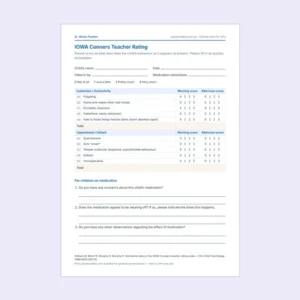
We will shortly review our first year in terms of the number treated, clinical outcomes and patient satisfaction. The clinical outcomes of interest are changes in teacher ratings using the IOWA Conners,6 growth parameters and adverse effects of medication (including medication changes made due to side effects). In the long term, we hope to increase the capacity for treating ADHD within the Nepean Blue Mountains Local Health District. This model of care could be expanded to include adults and implemented in other districts across Australia (in the first instance expanded into a multicentre study), ultimately empowering GPs to provide accessible, holistic care to their patients of all ages with ADHD.
References
- Drug Utilisation Sub-Committee PBAC. Attention deficit hyperactivity disorder: Utilisation analysis. Canberra: Australian Government; 2021.
- Commonwealth of Australia. Assessment and Support Services for People with ADHD. Canberra: Parliament House, Canberra Australia: Senate Printing Unit; 2023.
- Henry R. Review of Health Services for Children, Young People and Families within the NSW Health System. Australia: New South Wales (NSW) Government; 2019.
- Kwon S, Bhurawala H, Munoz A, Kramer J, Poulton A. General practitioners’ attitudes and knowledge about attention-deficit hyperactivity disorder (ADHD): Insights from a survey. Australas. Psychiatry 2023; 32: 18–22. 10.1177/10398562231211156CAS
- Hiscock H, Loughlin RO, Pelly R et al. Strengthening care for children: Pilot of an integrated general practitioner-paediatrician model of primary care in Victoria, Australia. Aust. Health Rev. 2020; 44: 569–575. 10.1071/AH19177PubMed Web of Science®
- Pelham W, Milich R, Murphy D, Murphy H. Normative data on the IOWA Conners teacher rating scale. J. Clin. Child Psychol. 1989; 18: 259–262. 10.1207/s15374424jccp1803_9Web of Science®